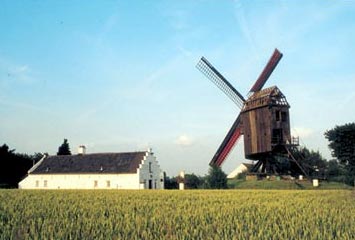
 Towards
the end of the 20th Century, the long-term future of the Hertboom Mill was in the balance. The windmill had been allowed to
fall into a state of disrepair (see photograph, left) and only extensive and costly repair and renewal works were likely to
guarantee its continued existence. Fortunately, it found a saviour in the form of Jozef Van Waeyenberge, who purchased the
mill and cottage at public auction in 1999. The new owner was determined to ensure the preservation of the Hertboom Mill and
instigated a programme of restoration which was designed return the mill to full operational status. Without this vital
undertaking, there is little doubt that the Hertboom Mill would, like the Kreikensmill formerly in nearby Pamel, eventually
collapse and vanish from the skyline of Pajottenland. Instead, today it stands proud, a national treasure that has been saved
for future generations to experience for many years yet to come.
Towards
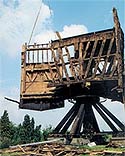
the end of the 20th Century, the long-term future of the Hertboom Mill was in the balance. The windmill had been allowed to
fall into a state of disrepair (see photograph, left) and only extensive and costly repair and renewal works were likely to
guarantee its continued existence. Fortunately, it found a saviour in the form of Jozef Van Waeyenberge, who purchased the
mill and cottage at public auction in 1999. The new owner was determined to ensure the preservation of the Hertboom Mill and
instigated a programme of restoration which was designed return the mill to full operational status. Without this vital
undertaking, there is little doubt that the Hertboom Mill would, like the Kreikensmill formerly in nearby Pamel, eventually
collapse and vanish from the skyline of Pajottenland. Instead, today it stands proud, a national treasure that has been saved
for future generations to experience for many years yet to come.
 The
restoration process began in 1999, with an extensive study of local archives and the Hertboom estate to determine the
scale, nature and detail of the work needed. Despite its increasingly dilapidated state, the windmill had been listed as
a monument of national heritage by the Royal Commission of Monuments and Landscapes since 1944. The institution would be
involved throughout the restoration work in a consultative capacity. Another organisation to become involved were
Monument Watch, who arrived to inspect the site prior to restoration. They compiled an inventory in minute detail of the
components of the mill and the layout of the estate. This was a vital part of the pre-planning for the works and went
hand in hand with exhaustive stock-taking, description, photography and video recording of the mill site and buildings.
This continued as the mill was taken down, to record each and every piece that went into its construction.
The
restoration process began in 1999, with an extensive study of local archives and the Hertboom estate to determine the
scale, nature and detail of the work needed. Despite its increasingly dilapidated state, the windmill had been listed as
a monument of national heritage by the Royal Commission of Monuments and Landscapes since 1944. The institution would be
involved throughout the restoration work in a consultative capacity. Another organisation to become involved were
Monument Watch, who arrived to inspect the site prior to restoration. They compiled an inventory in minute detail of the
components of the mill and the layout of the estate. This was a vital part of the pre-planning for the works and went
hand in hand with exhaustive stock-taking, description, photography and video recording of the mill site and buildings.
This continued as the mill was taken down, to record each and every piece that went into its construction.
 Ultimately, the windmill was completely dismantled in 2001, its constituent parts being packed
up and sent to the workshop of Robert Wieme. At the workshop, re-usable parts were renovated and lovingly crafted
replacements for rotted components were made with reference to drawings and information unearthed during the archival
investigations of 1999.
Ultimately, the windmill was completely dismantled in 2001, its constituent parts being packed
up and sent to the workshop of Robert Wieme. At the workshop, re-usable parts were renovated and lovingly crafted
replacements for rotted components were made with reference to drawings and information unearthed during the archival
investigations of 1999.
In addition to the restoration work carried out on the mill components, the foundation mound upon
which the windmill stood was also rebuilt and strengthened to guard against subsidence.
Reconstruction of the windmill started in 2001 and continued deep into the following year. The
job was long and painstaking, working from the notes, photographs, video footage and other research that had been made in
the run up to the dismantlement. Interested parties from all over the world were able to watch the restoration works in
progress via the windmill's website,
www.windmolen.be, which offered video streams from four webcams set up at various
locations on the estate. The three years of hard work to return the Hertboom Mill to its former glory were most definitely
worthwhile and the project managers were delighted to be able to re-open the windmill on Sunday 1st December 2002, when
they hosted a suitably festive celebration. Senne Rouffaer, 'Captain Zeppos', was one of the dignitaries who attended the
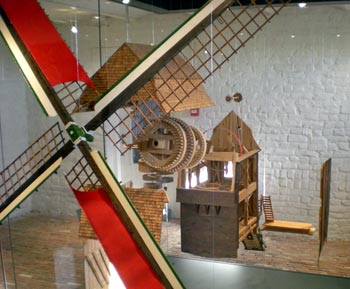
opening ceremony. The mill is now fully operational and has been augmented with a fascinating
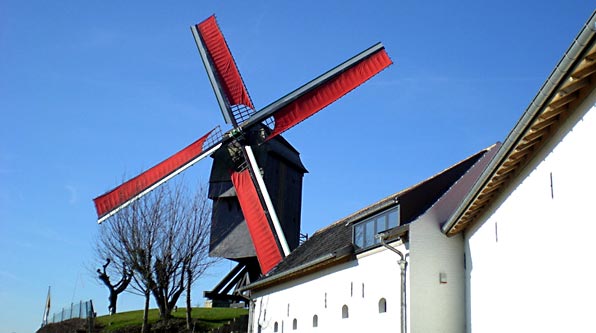
museum and a brasserie supplying food, drink and a warm welcome to visitors. Once again, the Hertboom Mill stands proud
on the skyline of Pajottenland, the unfortunate neglect of recent years a swiftly receding memory.
With grateful thanks to the
Hertboom Mill Museum
and
www.windmolen.be