|

 The
open countryside surrounding Wervik was another area visited by the
production crew of Kurrel & Co., with the limitations of a
certain prop dictating the choice of venue. Director, Ludovic Beun,
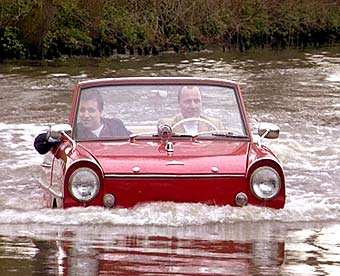
who was born in Wervik, revealed to Adventurer that "the car
chase was shot at Wervik because we needed a suitable place to drive
the amphibian car into the Leie. The car could only go in water at a
spot with a soft curve." In fact, the Amphicar posed another problem
for the film-makers - they had planned a wild car chase, but the
Amphicar could not get above 60 km/h. They eventually elected to
speed up the sequence in editing - but there was no denying that the
Amphicar was a remarkable asset to the production, and you look
after the prima donnas if they are worth the effort! The
open countryside surrounding Wervik was another area visited by the
production crew of Kurrel & Co., with the limitations of a
certain prop dictating the choice of venue. Director, Ludovic Beun,
who was born in Wervik, revealed to Adventurer that "the car
chase was shot at Wervik because we needed a suitable place to drive
the amphibian car into the Leie. The car could only go in water at a
spot with a soft curve." In fact, the Amphicar posed another problem
for the film-makers - they had planned a wild car chase, but the
Amphicar could not get above 60 km/h. They eventually elected to
speed up the sequence in editing - but there was no denying that the
Amphicar was a remarkable asset to the production, and you look
after the prima donnas if they are worth the effort!
The town of Wervik is divided by the
border between Belgium and France, with some of the territory in one
country and the rest in the other. The town's roots date back to
Roman times - excavations have revealed its past as a Roman
administrative centre and market town. It is believed that a temple
dedicated to Mars was once in use in the area known now as
St-Maartensplein.
In medieval times, the city of Wervik
came to notice when the cities of Bruges, Gent and Ypres were in
decline. However, in 1382, the town was destroyed by fire in the war
between the Seventeen Provinces and Spain and its inhabitants fled.
The town rose again, but in 1713 the town was split in two, with the
Northern area retaining its original name under the Austrians (the
half that now lies in Belgium) and the Southern part becoming
Wervicq Sud, under French rule.
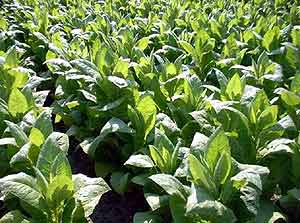 Today, Wervik is reknowned as the
major tobacco-producing town of Belgium, accounting for the
cultivation of over 95% of the country's total output in recent
years. Today, Wervik is reknowned as the
major tobacco-producing town of Belgium, accounting for the
cultivation of over 95% of the country's total output in recent
years.
Every September, the town holds a tobacco harvest festival,
with a tobacco fair a month later. There is also a museum devoted to
the tobacco industry. |