|
 Some thirty one years after the cameras last turned on Kapitein Zeppos in 1968, when the chance
of a revival of the series seemed long gone, there was suddenly a glimmer of hope for fans of the Captain. The Millennium is
drawing rapidly to its close and the story moves to Brussels, to the
Erasmushogeschool, where in the
RITS department - for
those studying the drama and television/film techniques - student Ludovic Beun has struck upon an ambitious idea for his practical
project - to revive the classic Belgian youth-series Kapitein Zeppos. Some thirty one years after the cameras last turned on Kapitein Zeppos in 1968, when the chance
of a revival of the series seemed long gone, there was suddenly a glimmer of hope for fans of the Captain. The Millennium is
drawing rapidly to its close and the story moves to Brussels, to the
Erasmushogeschool, where in the
RITS department - for
those studying the drama and television/film techniques - student Ludovic Beun has struck upon an ambitious idea for his practical
project - to revive the classic Belgian youth-series Kapitein Zeppos.
As an idea, it wasn't necessarily unusual. Who else has set upon the task of making a home movie
of a childhood favourite at some time? I know I have. The difference here is that Ludovic Beun achieved his dream, while the
vast majority of us - myself included - gave up when the going got tough (or even before!). And the other difference is that in
no way whatsoever can Kurrel & Co. be considered a home movie. It's a professional standard production, with a great
cast, superb direction and lighting and an intriguing storyline. It manages to capture the spirit of the original
Kapitein Zeppos series and yet still exudes a modern style and atmosphere. The only drawback is that it is
designed as being the opening episode of a serial - and the remainder of the serial was never made (indeed, was probably never
intended to be made). More's the pity.
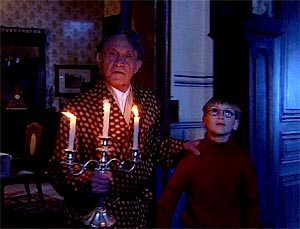 The production standards are sky high - and the cast remarkable. How many coursework projects
can boast an appearance by an actor of the reputation of Senne Rouffaer? Or a star turn by Bert Struys, the very man who had
made so many of those youth-series that had proven so inspirational? Rouffaer reprised his role as Captain Zeppos in a cameo
sequence in the video, where he speaks on the telephone to his old friend, Ben Kurrel. Struys' role was, however, more central
to the story - as 'Opa' (grandfather), the old man who is abducted and interrogated by the art thieves. There is also a lovely
touch in the script, where he is mentioned in dialogue as a fictitious Flemish painter - "Struys, the well-known Flemish
avant-garde painter". Kurrel & Co. proved to be one of the last professional engagements for Bert Struys, who sadly
died in 2000 aged 80. He simply shines in the role and Kurrel & Co. is undoubtedly a tribute to him as much as it is
to Kapitain Zeppos. A fitting epitaph. The production standards are sky high - and the cast remarkable. How many coursework projects
can boast an appearance by an actor of the reputation of Senne Rouffaer? Or a star turn by Bert Struys, the very man who had
made so many of those youth-series that had proven so inspirational? Rouffaer reprised his role as Captain Zeppos in a cameo
sequence in the video, where he speaks on the telephone to his old friend, Ben Kurrel. Struys' role was, however, more central
to the story - as 'Opa' (grandfather), the old man who is abducted and interrogated by the art thieves. There is also a lovely
touch in the script, where he is mentioned in dialogue as a fictitious Flemish painter - "Struys, the well-known Flemish
avant-garde painter". Kurrel & Co. proved to be one of the last professional engagements for Bert Struys, who sadly
died in 2000 aged 80. He simply shines in the role and Kurrel & Co. is undoubtedly a tribute to him as much as it is
to Kapitain Zeppos. A fitting epitaph.
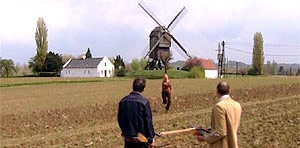
The other nods to the heritage of Kapitein Zeppos are the extensive use of Onze-Lieve-Vrouw-Lombeek
windmill as the Mill Cottage (now the home of Dr. Ben Kurrel, his niece Annemie and Jeroen, a young criminology student, since Zeppos'
departure for Crete), the return of Zeppos' famed Amphicar and the use of Bert Kaempfert's Living It Up, equally well-known
as the Kapitein Zeppos theme tune. Fans of the series in Belgium were no doubt as delighted as I was to see and hear these
inclusions, which were delightful, authentic flourishes on the canvas of this affectionate revival.
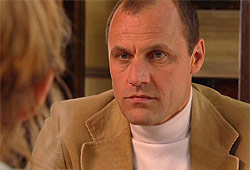 That's the past dealt with, so what about the new elements? For a start, the central cast of
Steph Baeyens (Ben Kurrel), Mathias Sercu (Jeroen Winters) and Tine Reymer (Annemie Mees) are excellent. I imagine the role
of Ben was recast to allow for a younger actor than Raymond Bossaerts (the original Ben), who was 61 at the time. Steph
Baeyens does a splendid job and within minutes of being introduced to him, the viewer can easily accept this new Ben. He is
perhaps harder-edged than Bossaerts' portrayal, but this is an older Ben, one who has changed subtly with the years. In a way,
it has a nice logic to it. Captain Zeppos has gone away and now Ben assumes his role in the story. That's the past dealt with, so what about the new elements? For a start, the central cast of
Steph Baeyens (Ben Kurrel), Mathias Sercu (Jeroen Winters) and Tine Reymer (Annemie Mees) are excellent. I imagine the role
of Ben was recast to allow for a younger actor than Raymond Bossaerts (the original Ben), who was 61 at the time. Steph
Baeyens does a splendid job and within minutes of being introduced to him, the viewer can easily accept this new Ben. He is
perhaps harder-edged than Bossaerts' portrayal, but this is an older Ben, one who has changed subtly with the years. In a way,
it has a nice logic to it. Captain Zeppos has gone away and now Ben assumes his role in the story.
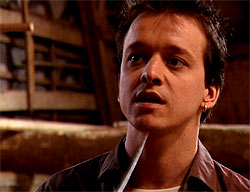 Those looking for the modern equivalent of the youthful enthusiasm and bravado of the Sixties' Ben Kurrel need
look no further than Jeroen Winters, the young criminology student, played by the excellent Mathias Sercu. Although Jeroen is clearly Number 2
in the pecking order at the Mill Cottage, learning - often the hard way - from the master about all manner of sporting and investigative
disciplines, Sercu makes the part his own and is as much the star of Kurrel & Co. as Ben Kurrel himself. Tine Reymer, as Ben's
niece Annemie, is both convincing and engaging. Despite the short screen time she is given, Reymer's confident performance
makes her character memorable.The three new leads are all exceptionally well cast and would easily have been
capable of carrying a full series of Kurrel & Co.. The remainder of the programme's cast are equally effective. Those looking for the modern equivalent of the youthful enthusiasm and bravado of the Sixties' Ben Kurrel need
look no further than Jeroen Winters, the young criminology student, played by the excellent Mathias Sercu. Although Jeroen is clearly Number 2
in the pecking order at the Mill Cottage, learning - often the hard way - from the master about all manner of sporting and investigative
disciplines, Sercu makes the part his own and is as much the star of Kurrel & Co. as Ben Kurrel himself. Tine Reymer, as Ben's
niece Annemie, is both convincing and engaging. Despite the short screen time she is given, Reymer's confident performance
makes her character memorable.The three new leads are all exceptionally well cast and would easily have been
capable of carrying a full series of Kurrel & Co.. The remainder of the programme's cast are equally effective.
Possibly the biggest difference between this and the original Kapitein Zeppos series is
that this production was made on videotape rather than on film. This is initially a little off-putting - it all seems a little
too immediate compared to the original - but the direction and camerawork is so slick that it is quickly put to the back of
the viewer's mind as they sit back and enjoy the ride.
As a student project, Kurrel & Co. was never intended for broadcast, although it is
undoubtedly head and shoulders above the standard of much of today's television drama. It was four years before fans of
Kapitein Zeppos could get to see Ludovic Beun's 20-minute production. In 2003, Kurrel & Co. was presented
as an extra feature on the DVD edition of the first series of Kapitein Zeppos from Vintage Films.
Kurrel & Co. is a wonderful revival of - and tribute to - the original
Kapitein Zeppos series, but one that leaves the viewer wanting much, much more. Unfortunately, it looks like it's
a glorious one-off: the proof that it is possible to update an old television show and make it work without compromising the
spirit of the source material. The producers of the Hollywood versions of The Saint, The Avengers and
Mission: Impossible should take note. It can be done!
Postscript: It will come as no surprise to readers to discover that Ludovic Beun was not
only successful with this, his graduation project, but that he now works regularly in Belgian television. Among his recent
directorial work are Bracke en Crabbé (2000), De Laatste Week (2001-) and Aan Tafel (2001).
|