 Beguinages
were religious communities set up by the church for 'Begijns' or
'Beguines', who were women who dedicated themselves to a religious
existence but who maintained their own property and did not depend
financially upon the church. Dating back as far as the Thirteenth
Century, the movement was very strong throughout the Low Countries.
Beguinages
were religious communities set up by the church for 'Begijns' or
'Beguines', who were women who dedicated themselves to a religious
existence but who maintained their own property and did not depend
financially upon the church. Dating back as far as the Thirteenth
Century, the movement was very strong throughout the Low Countries.
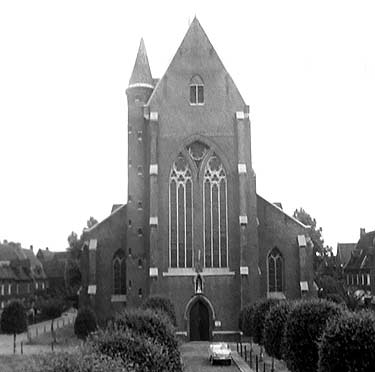
This particular group of buildings, the Groot Begijnhof,
Sint-Amandsberg (Great Beguinage of St. Amandsberg) in Gent, is much
more recent, dating from the 1870s. The imposing and impressive church of St.
Amandsberg sits proudly at the centre of its little community, which
is enclosed within a surrounding wall and connected by a series of
narrow, winding roads leading to the wide, grassed squares and
gardens. Along these roads and around the perimeter of the main
squares are dotted the modest but attractive two-storey residences
of the beguines.
The St. Amandsberg beguinage was designed by Arthur Verhaegen and
built between 1872-1875 following the dismantling of the St.
Elisabeth beguinage in 1860, which itself is believed to have dated
back to 1234. The St. Amandsberg church was built at the same time
as the new beguinage, designed in neo-Gothic style by Baron
Jean-Baptiste Bethune.
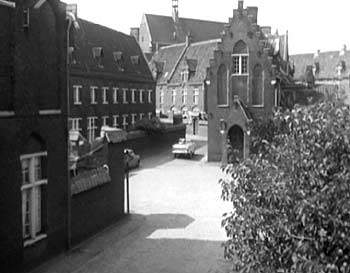 In
Kapitein Zeppos, the beguinage buildings in the central
square double for the headquarters of Tweng, an organisation devoted
to maintaining peace (an appropriate location, you might say). We
first see it as the Captain drives his Amphicar through the
medieval-style entrance gate of the outer wall and along the winding
roads, passing along the side of the church before coming to a halt
in the road that dissects the central square opposite the entrance
to the church. Tweng's headquarters are situated behind the door
(numbered '67') directly facing the end of the road he has parked
the Amphicar on. Sequences were filmed inside, although the main
Tweng complex is quite obviously at another locale. Interior scenes
featuring Zeppos, Elias and Marleen are thought to have been filmed
in the beguinage houses. The sequences in the garden featuring these
same characters were also shot in the beguinage area.
In
Kapitein Zeppos, the beguinage buildings in the central
square double for the headquarters of Tweng, an organisation devoted
to maintaining peace (an appropriate location, you might say). We
first see it as the Captain drives his Amphicar through the
medieval-style entrance gate of the outer wall and along the winding
roads, passing along the side of the church before coming to a halt
in the road that dissects the central square opposite the entrance
to the church. Tweng's headquarters are situated behind the door
(numbered '67') directly facing the end of the road he has parked
the Amphicar on. Sequences were filmed inside, although the main
Tweng complex is quite obviously at another locale. Interior scenes
featuring Zeppos, Elias and Marleen are thought to have been filmed
in the beguinage houses. The sequences in the garden featuring these
same characters were also shot in the beguinage area.
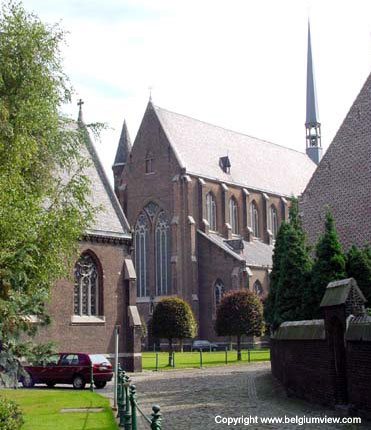 The St. Amandsberg beguinage is accessible to the general public,
and although it is not a working church community as in the past,
the tradition of the beguines continues, as a small number of them
continue to live in the beguinage dwellings. The beguinage is a
beautiful part of Gent that is well worth a visit.
The St. Amandsberg beguinage is accessible to the general public,
and although it is not a working church community as in the past,
the tradition of the beguines continues, as a small number of them
continue to live in the beguinage dwellings. The beguinage is a
beautiful part of Gent that is well worth a visit.